Saturday, 15 July 2023

Discovery in Dundee

This morning we went by bus to Broughty Ferry where the local lifeboat station was having a day of festivities to raise money for the RNLI. Among other excitements was the rescue of a dummy that had jumped - or maybe he was pushed- off a bridge into the sea. It was all well organised and there were plenty of children looking at the exhibits. 
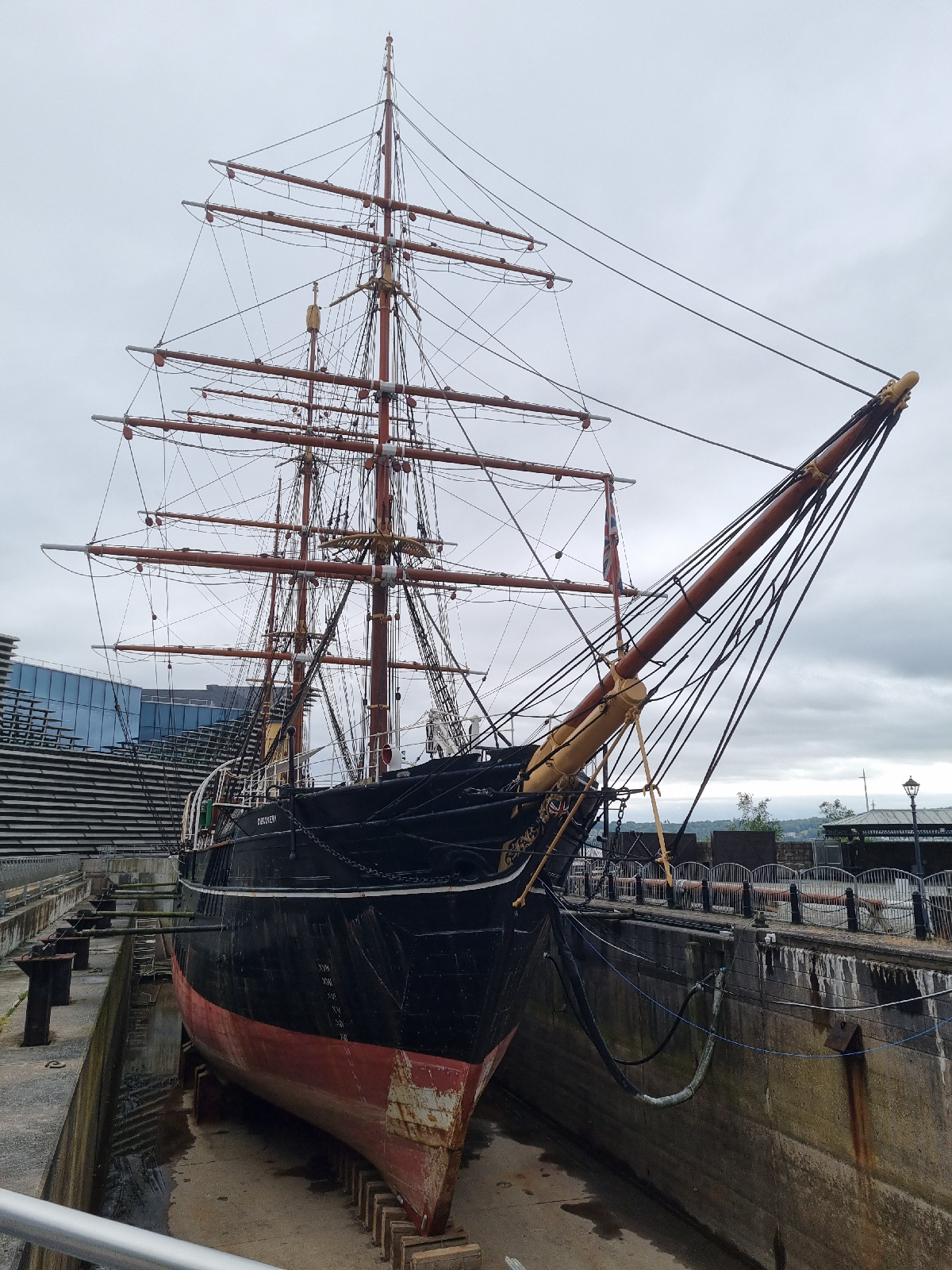
In the evening we went to Dundee where the Gaffers had a private guided tour of the Discovery. This is an antarctic exploration ship, built in Dundee in 1901 and occupying a prominent position between the station and the river.The Discovery had a very successful career and was used in several important expeditions. She has massive wooden construction and is enormously strong. Unfortunately it is hard to prevent rot in heavy timber construction, but we were impressed by the efforts being made for her preservation. We enjoyed looking round her, though I think our volunteer guide struggled a bit with some of the Gaffers more technical questions.
We then had supper in a gallery overlooking the ship. 
This is the culmination of our visit to Dundee, ably organised by Alison and Julian Cable, who  also arranged our very successful visit to Oban earlier this month.
Yesterday's stormy weather seems to be passing on, and we hope soon to be able to make progress heading south.

Friday, 14 July 2023

Tayport again

The picture shows some of the very many dolphins that accompanied us into the River Tay yesterday. The tides are very turbulent in the entrance to the river and maybe that makes it easier for them to find fish.
This morning we woke up to a moderate breeze, but the forecast was a bit grim - easterly gales and plenty of rain. We thought it would be wise to move the boat at high tide to the sheltered harbour of Tayport on the other side of the river. Our old friends Edgar and Else on their lovely steel yacht Windbreker are here too and they went into Tayport just ahead of us. They were with us on the 2013 round Britain cruise, and on our trip to Holland in 2014: it was lovely to see them again and admire the many improvements to their boat. 
In the evening it did indeed blow hard, with a gale from the east and plenty of horizontal rain. We had a curry in the excellent Bell Rock restaurant and on getting back to the boat were grateful to be moored head to wind in a secure harbour.

Broughty ferry

Our crew was greatly strengthened by the arrival of D yesterday and this morning, after a cooked breakfast ashore and some essential shopping, Allan, D and I decided it was time to move on. We left the tidal harbour of Anstruther at about 11, around an hour before high water, and headed south across the Firth of Forth to have a look at Bass rock. This is an extraordinary isolated rock that is the home to millions of seabirds. 
Without any preditors, we wondered, do they lead untroubled carefree lives  or maybe is there rivalry between different species or trouble between neighbours who push their luck by encroaching on other birds territory? 
We could not answer these questions. We had a brisk SW wind and had a reef in the mainsail most of the time. After  inspecting Bass rock we crossed St Andrews Bay and entered to mouth of the river Tay. This is surrounded by notorious sandbanks, prone to constant movement, but we eventually threaded our way in, tacking against a blustery wind. This evening finds us on a buoy of the Royal Tay Yacht Club, on the North side of the Tay, at Broughty Ferry a few miles from Dundee. I have never been here before, but D used to sail dinghies off the beach here many years ago with her friend Angela.
We hope to meet up with some more Gaffers here tomorrow.

Monday, 10 July 2023

Anstruther

Allan joined us yesterday and having never sailed in Scottish waters before was keen to see some of the coastline. We have to be back in Dundee at the end of the week for the Gaffers gathering but that should give plenty of time for a bit of exploring. So we left Tayport this morning  at high water and headed down the Tay. We had a range of options of places we could go to depending on the weather, but the wind was light and variable and we didn't want to do a lot of motoring. We sailed round Fife Ness into the Firth of Forth. Anstruther was the most practical place to head for but I was a bit anxious as the harbour dries out at low water and reading the pilot book it was hard to find out where a boat like Bonita could berth safely. We tried to contact the harbour master but he had long since gone home. With Allan on the helm we got into harbour at half tide without touching the bottom. The picture shows the approach to the entrance. 
We found all the berths indicated as being suitable for a larger boat were occupied by local fishing boats. We eventually tied up alongside a large motor boat. Bonita will probably touch the bottom at low tide, but it all seems to be soft mud, so I hope that will be OK.
The picture shows our bit of the harbour, with the town behind, before the rain set in. We had supper in a restaurant certified as providing the best fish and chips in Scotland. It was certainly very good, but I suspect we might have seen other places with similar certification while on our travels.

Dundee

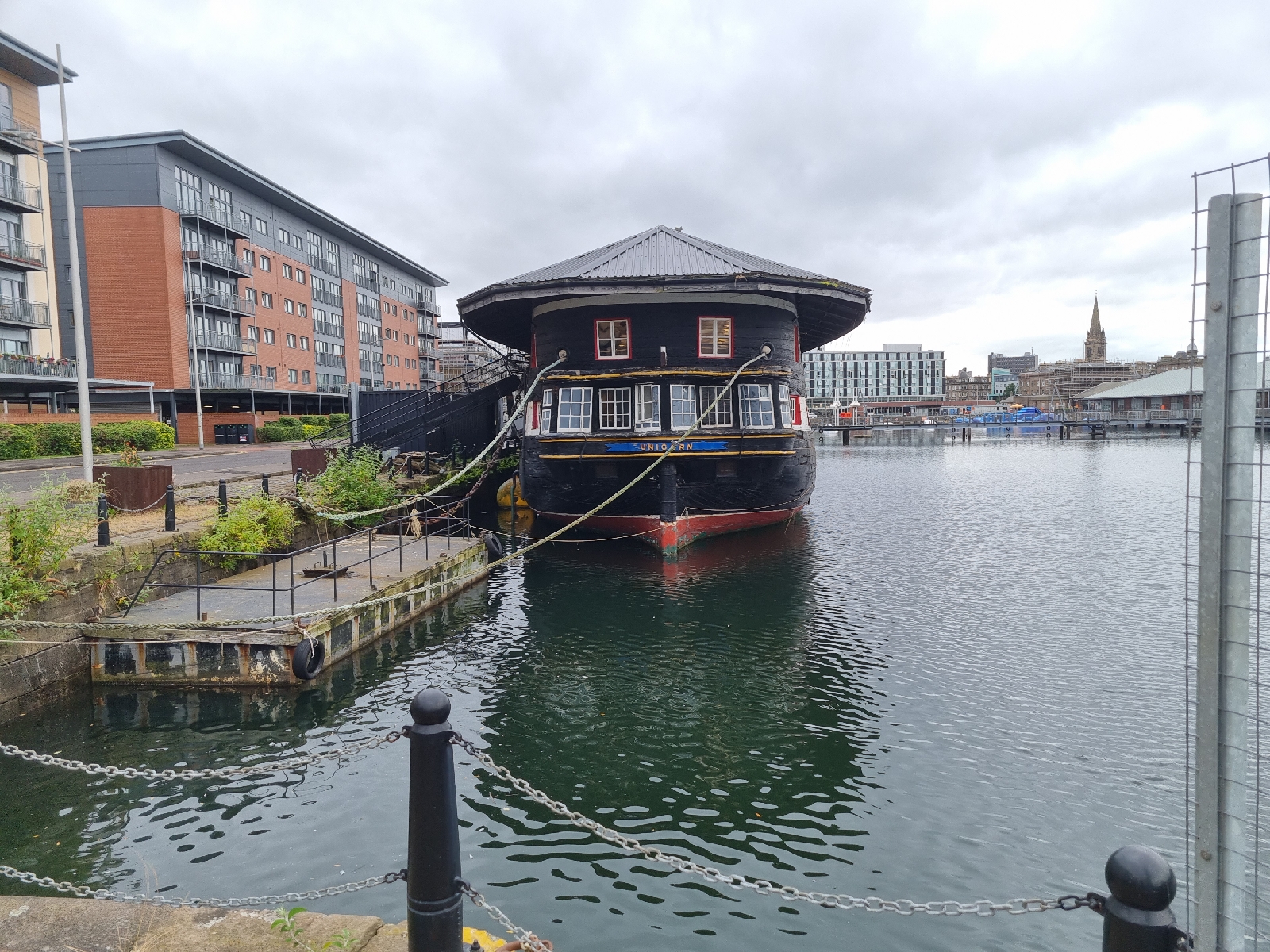
Today Tim and I left the boat in Tayport and took the bus the few miles to Dundee. There is lots to see there. We went to see HMS Unicorn as Tim has been involved in consultancy work concerning her preservation.
The Unicorn is a unique survivor. Built for the Royal Navy as a wooden frigate in 1824, she was never used. On completion she was roofed over to keep the rain out  and stored afloat so if needed she could be put into service at short notice. This never happened and she was soon made obsolete by the coming of steam power.  She has a number of interesting features, including iron diagonal straps that were used to reinforce the later wooden warships. She is afloat in a dock near the city centre, and is looked after by a passionate team of volunteers. The pictures show her afloat and still roofed over, the gun deck, and an internal view of her bilges which I thought were surprisingly dry considering her age. The diagonal iron straps can be seen in the view of the bilges.
This is a view of the rail bridge over the river Tay, opened in 1887 By each of the bridge supports there is the stump of a support from a previous bridge. This was the rail bridge which partially collapsed in 1879 while a passenger train was going over it during a December storm. The bridge was less than a year old at the time. The subsequent enquiry found poor design, poor quality control and poor maintenance were all factors. The remains of the old bridge were all removed apart from the stumps of the piers. The lessons learnt were used in the design of the current Tay bridge and the Forth rail bridge opened in 1889.

Sadly Tim now has to go home tomorrow after getting us all the way from Inverness, so Bonita is awaiting new crew.